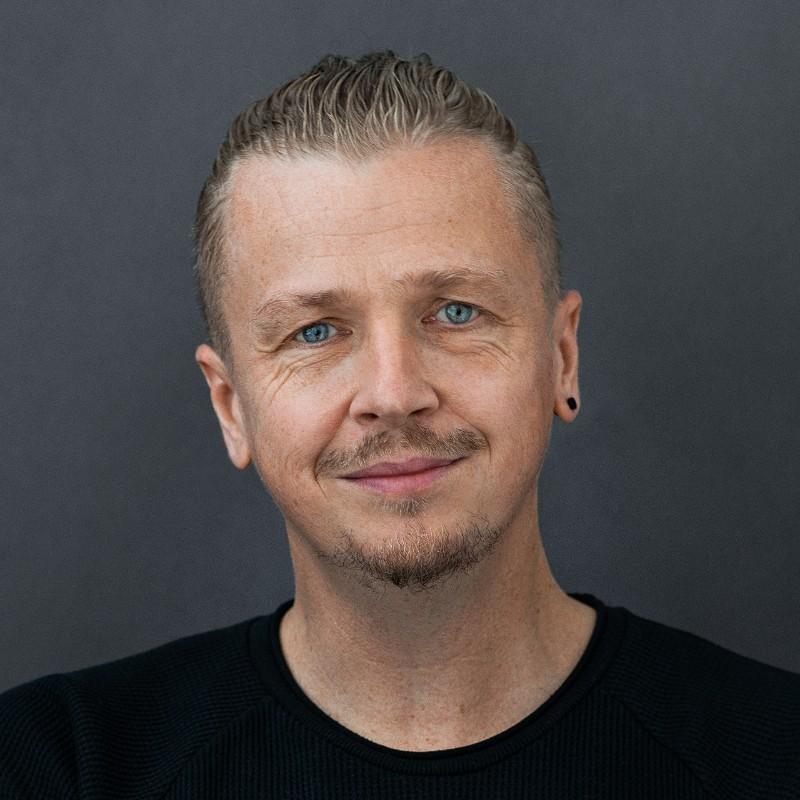
I spent my student years on two things: studying geodesy, and painting graffiti. Coordinate systems and projections in the daytime, typography, composition and colour at night, with a few exhibitions in the Netherlands and Thailand.
The intersection between engineering and design is what drew me to web development in 2008. First Flash, then Linux, accessible and semantic HTML & CSS, later Canvas & WebGL, and a long stretch of creative coding: shaders, motion, interactive installations, web-based games. I have never minded a mathematical rabbit hole if that's what the feature needed.
Restor is where it all converged. For almost four years I was the sole frontend architect for the geospatial and data visualisation features of the world's largest network of restoration sites: thirty-one map-based data layers, GLSL shader overlays with live value inspection, a polygon drawer that stays smooth at 20,000 vertices, and twelve chart primitives behind 23 chart components, used in 100+ places across the product. The case study has the details.
I still work at the visually ambitious end of frontend. Earlier this year I finished a navigable 3D render of Los Angeles for a digital billboard network, down to direction-aware spatial audio.
Right now I split my time between two things. Fahsai is a map of Thailand's burning season that I designed and built solo, from the ingestion pipelines to the map; it's also where I worked out an AI-augmented workflow that keeps Claude Code's output consistent and reviewable. And I'm the AI implementation partner for Aster, a Dutch policy consultancy, part-time. I set up their Claude workspace, wrote the Agent Skills their consultants use for work like Dutch legal citation checks and monthly reporting, and built a remote MCP server for their hours data with its own OAuth flow. Now I'm building their policy monitor: each month it collects legislation and news per domain, has agents check every item for correctness and relevance, and turns the result into a newsletter.
How I work with AI
In the product. Fahsai's “What's causing this?” traces the air back 72 hours and classifies the day before Gemini writes a word. Sixteen hand-checked station-days and an eval script keep it honest. The same backend is an MCP server, so other models can use it too.
In how I build. Claude Code writes a lot of my code, inside guardrails: my conventions as skills it loads before writing or reviewing, hooks that gate on lint and tests, and pull requests kept small enough to actually review. AI review runs on every pull request, but it never signs off on changes with a large blast radius: auth, migrations, or code the rest of the app depends on. Those I read line by line.
In a business. On the Aster policy monitor, Claude kept pushing for a fully agentic pipeline. I kept the agents to the one step that needs judgement, deciding what's relevant, and let API calls and a database do the rest.
Frontend and interaction design are where I'm strongest. I also handle the backend a product needs: the data model, the API that feeds the map, the ingestion jobs, the deployment. I won't design your brand identity or architect your event-streaming backbone, though. I'm going deeper on the infra side, taking Fahsai to production with CI, migrations, tests and containers. Solo or in a larger product team, give me the problem and the constraints and I'll come back with questions first, then with something that works.
Experience
2026 – now
Aster, Amsterdam
AI implementation partner (freelance, part-time)
Set up the consultancy's Claude workspace and built its Agent Skills, a monthly financial reporting pipeline, and a remote MCP server with its own OAuth flow.
2026 – now
Fahsai
Personal project, open source
Designed and built a live air quality map end to end: ingestion jobs, API, map UI and an AI explanation layer.
2025 – 2026
Triple / Hypersolid, Alkmaar
Creative frontend developer (freelance)
Took over and finished a navigable 3D Los Angeles for a digital billboard network. Built the small-billboard features, media plan quoting, the AI concierge front end and directional spatial audio.
2022 – 2025
Restor.eco, Zurich (remote)
Senior geospatial frontend engineer (consultant)
Sole architect of the map and data visualisation frontend. On my own initiative, built the frontend for Restor's country dashboards for its UN partnership.
2022
Engage Works, London (remote)
Frontend lead (consultant)
Refactored and extended a CMS for interactive presentations on 6K touchscreens. Generated monochrome Mapbox styles for any brand colour by reverse-engineering a Studio-only feature.
2021 – 2022
Lab Digital, Utrecht
Senior frontend developer (consultant)
Built e-commerce and content platforms for Heineken, Heijmans and SLB, including fixes from a WCAG audit.
2013 – 2021
Kaliber Interactive, Utrecht
Senior creative frontend developer
Led technical delivery for KLM, T-Mobile and banen.bol.com, and worked on Rabobank, Nespresso and Dutch government platforms. Co-established the agency's React way of working with the CTO, wrote its frontend architecture guidelines, and mentored juniors.
2008 – 2014
Freelance
Full-stack web developer
Built websites and web apps for clients on five continents.
BSc Geodesy, HU University of Applied Sciences Utrecht, 2001
Got a product where the data is the hard part?
I'm looking for my next product engineering role on a data- or map-heavy product. Based in Utrecht, The Netherlands.
dev@joostkiens.com